The first trade came at 11:48 a.m.
It was more than two hours late. Too many buyers, not enough sellers. When it finally printed, one share of Anthropic cost $111.50. The night before, the bankers had priced it at $83.
That is a 34% jump in a single trade. On paper, the company behind Claude was suddenly worth close to $2 trillion.
The deal raised about $81 billion. That's more than SpaceX raised in June. Orders came in up to seven times what was available. Big funds got only about half of what they asked for.
But the number that stayed with me wasn't on the ticker. It was in the filing.
Anthropic tells its new shareholders that its technology could help cure diseases. In the same document, it warns about bioweapons. About instability between nations. About humans losing control of AI.
Most companies hide their worst fears in the fine print. Anthropic put them in the sales pitch. And today, investors lined up around the block to buy it anyway.
Four ways to read the same company
Ask ten investors about Anthropic and you'll hear four stories.
The believers start with the growth. Seventeen billion dollars in sales last quarter. That's more than 12 times a year earlier. Big business customers went from about 950 to nearly 12,000. To them, this is the steam engine. Or electricity. A crash along the way wouldn't change that, any more than the dot-com bust killed the internet.
The valuation hawks don't argue with the business. They argue with the price. Aswath Damodaran teaches valuation at N.Y.U. and is about as famous as that job gets. He ran the numbers and got about $1.48 trillion. To get there, Anthropic has to reach around $1 trillion in yearly sales by 2036. He calls that plausible. Not likely. He won't buy much above his number. He won't bet against it either.
The skeptics point at the slope. Sales grew 144% from the first quarter to the second. From the second to the third, 47%. Cheaper models, many from China, are catching up. Companies are watching their AI bills. Gary Marcus, a longtime critic, calls the IPO a bad bet. The company also swung from a profit in the spring to a loss in the summer.
The fourth group cares less about money and more about power. The seven co-founders keep 50.1% of the votes. An independent trust picks most of the board. Public shareholders get the upside. They get almost no say.
Underneath all four stories sits one question. Will Anthropic still say no, to a big customer, to a rushed launch, once there's a stock price to protect?
What a stock price does to a company
Yesterday, Anthropic answered to a few dozen investors who signed up for the long game. Today it answers to a number that changes every second.
That number has a way of getting into the room.
Every three months, analysts will compare results to their guesses. A company priced at 16 to 20 times its sales doesn't get many quiet quarters. Miss once, and the stock can lose a third of its value in a week.
Then there are the employees. Thousands of them now hold shares they can see priced on their phones. When the lockups end over the next six to 12 months, many will be millionaires on paper. Every delay that costs a quarter of growth will cost them, too.
And there are the bills. Anthropic has promised to spend about $900 billion on computing power and data centers. Around $70 billion of that is due in the next 12 months. Most of it can't be cancelled. Commitments like that push a company to sell, and sell fast.
Anthropic saw all of this coming. It built walls.
It's a public benefit corporation, which lets the board put safety ahead of profit without getting sued. The founders control the vote for up to 10 years. An independent trust, whose members own no stock, elects most of the board. Put simply, Wall Street can't fire the chief executive for slowing down.
Will the walls hold? History isn't kind. Two Harvard Law scholars studied the only three companies that tried this kind of setup. Ben & Jerry's. OpenAI. Anthropic. At Ben & Jerry's, the parent company overrode the mission board. At OpenAI, the board fired Sam Altman, then took him back days later. Anthropic's trust can be dissolved by a supermajority of investors. That's a safety valve. It's also a door.
Here's what I think. The structure won't stop Anthropic from growing. It might let its leaders say no once or twice, when it counts. Whether they ever do will tell us more than any earnings call.
The race nobody can afford to lose
OpenAI won the crowd. ChatGPT neared 900 million weekly users this year. But its grip is slipping. Its share of chatbot traffic fell from about 87% to 68%, while Google's Gemini climbed.
Anthropic went the other way. It chased businesses, not households. By spring, companies were spending more with Anthropic than with OpenAI. Much of that came from programmers using Claude to write code.
Business customers are less exciting. They are also harder to lose. Once AI is wired into how a company works, switching is painful.
The strangest part is who owns the company now. Amazon holds about 15%. Google holds about 13%. Microsoft, Nvidia and others bought $26 billion more in a side deal. Some of them sell Anthropic its chips and cloud. Some of them compete with it directly. Google sells Gemini. Microsoft is OpenAI's biggest backer.
Meanwhile, the floor is dropping. Cheaper models keep closing the gap on everyday tasks. "Good enough" AI is getting cheap. Anthropic is betting the hard work, like code, agents and anything a business can't afford to get wrong, will still command a premium.
And OpenAI is next. It's expected to list at around $1 trillion. Once both companies trade side by side, every price cut by one becomes the other's problem. That's when competition gets expensive.
What does that mean for the rest of us? More AI that does work instead of just chatting. Higher prices for the best models. Lower prices for everything else. And a growing web of deals between companies that are partners on Monday and rivals on Tuesday.
Six futures for one stock
I wanted to see past the hype, so I built a simple model. Take today's sales, about $70 billion a year. Grow them for three years. Multiply by what the market might pay. Divide by the number of shares.
Then I told it six stories.
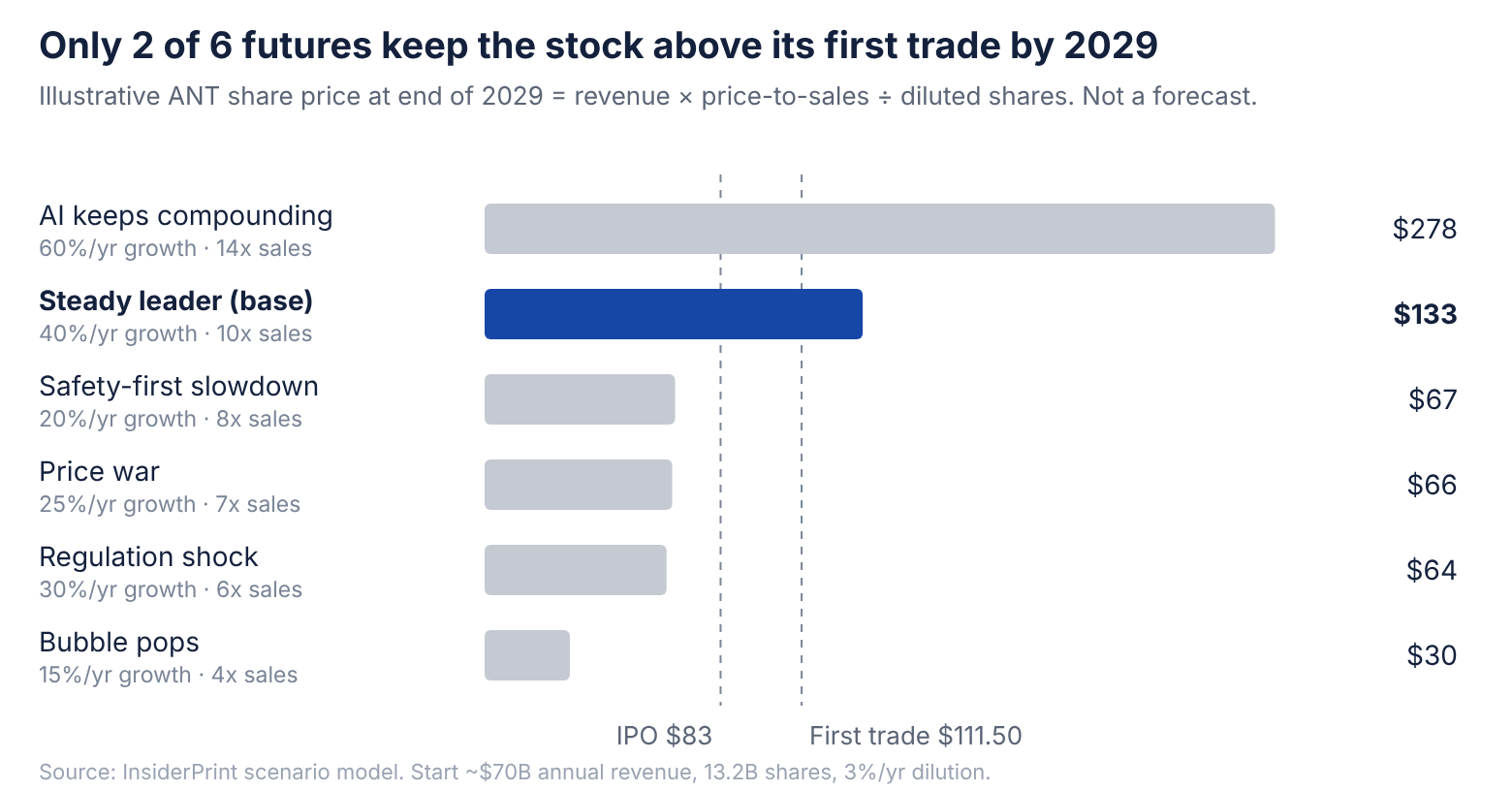
In the middle story, Anthropic grows 40% a year and stays the leader. The stock ends near $133. A fine outcome.
But look at the rest. Four of the six end below the IPO price of $83. One of those four is the "safety-first" story, where Anthropic chooses to slow down.
That's the whole tension of this IPO in one chart. The most responsible thing the company could do is also one of the worst things for its stock.
I ran it 100,000 more times with random numbers. Half the runs ended above $83. About four in ten beat the first trade of $111.50. More than one in five fell below $50.
None of this is a forecast. Nudge growth or the multiple a little, and the answer swings by hundreds of dollars. That's exactly why this stock will be a wild ride.
The day that will matter more than today
Three things are true at once.
This is a real business. Seventeen billion dollars in a quarter is not a bubble story. AI that writes code and does office work isn't going away.
The price already assumes a lot. At these levels, Anthropic needs years of fast growth just to earn where it started. Growth is already slowing. A few soft quarters could cut the stock by a third, even if nothing goes wrong inside the company.
And the real test isn't financial.
For years, Anthropic has said it would slow down if a model looked too dangerous. Its own filing says it believes an important safety threshold has already been crossed. Until now, keeping that promise cost the company very little. Starting today, it could cost shareholders billions.
Someday, maybe soon, Anthropic will delay a launch for safety reasons. The stock will fall. Analysts will grumble. Employees will check their phones.
That day will tell us more about the future of AI than anything that happened at 11:48 this morning.
Until then, here's what I'm watching. Whether growth settles above 30% a quarter. Whether sales can outrun $70 billion in computing bills. When the lockups end, and who sells. And what happens when OpenAI joins it on the market.
If you're tempted to buy, remember one thing. Hot IPOs often cool off. The first-day pop is rarely the best price you'll see.
Sources
Figures come from news coverage of the filing and first-day trading on the morning of Nov. 19, 2026. The scenario model is my own illustration. This is not investment advice.
- Anthropic IPO live: ANT's first day of trading, StockTitan
- Anthropic stock pops 30% in mega IPO, Fortune
- Anthropic IPO price band, valuation and listing date, INDmoney
- Anthropic IPO targets November debut as valuation expectations fall, Yahoo Finance
- The Anthropic IPO arrives: my valuation, Aswath Damodaran
- Is Anthropic's IPO a bad bet?, Gary Marcus
- Things to think about as Anthropic stock goes up and/or down, Mathew Ingram
- Who's really in charge at Anthropic after the IPO, TechCrunch
- Harvard Law: AI governance and "Ben & Jerry's risk", Yahoo Finance
- OpenAI-Anthropic enterprise rivalry heats up, Axios
- OpenAI misses user and revenue targets, TMGM